Free template
History Presentation Template for Sources, Events and Perspectives
This history presentation template gives teachers, students and speakers an eight-slide PowerPoint toolkit built around a fictional river town called Riverton, 1880 to 1920. After a cover titled History in Context, a context slide frames place, change and a guiding question. A four-point timeline then marks 1880, 1895, 1910 and 1920, followed by three fictional portraits that show how a market vendor, a railway worker and a town councillor might see the same changes. The middle slides add an illustrated bird's-eye map with a legend, compass and scale bar, then three aged-paper cards for comparing a market ledger, a railway notice and a council minute. A cause and effect chain from railway access to wider markets to workshop growth leads into closing discussion questions about missing voices and evidence. Parchment-cream backgrounds, black engravings, serif headings and copper accents give this editable PPT deck a vintage archive look. It is a reusable history education presentation you can adapt in PowerPoint, then convert to Google Slides.
To build a history deck on your own topic, try Deckgist's AI presentation maker to turn lesson notes, reading lists, and source PDFs into structured, editable presentations.
Create a presentation with AI
Enter a topic or upload reference files, then choose a theme to create a new presentation.
Create with a theme
Enter a topic or upload reference files, then choose a theme to create a new presentation.
Supports documents, PDFs, PPTs, and text files
Generate an editable presentation
AI organizes your content and completes the layout
No topic or upload needed
No topic or upload needed
What’s included
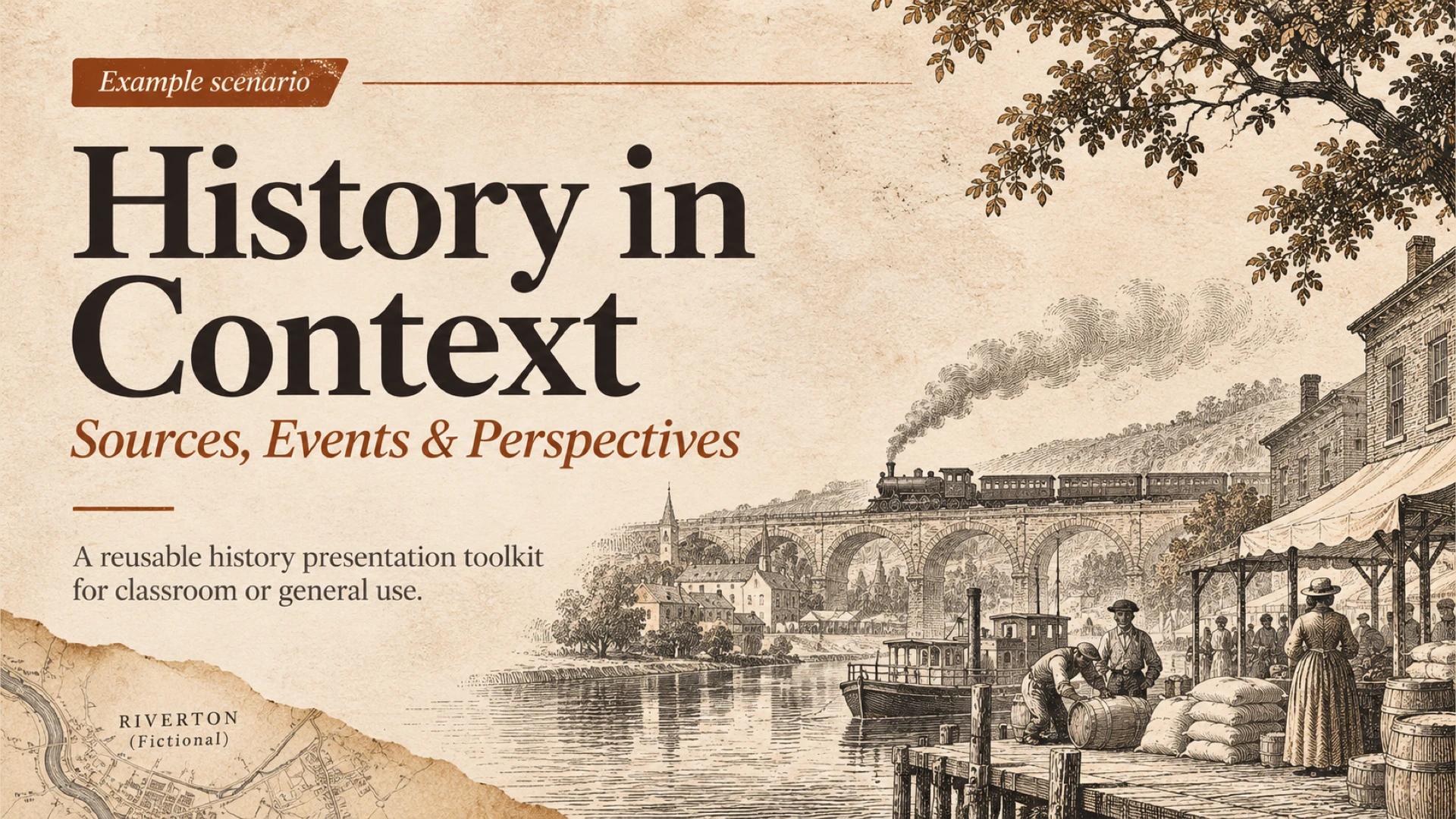
Cover: History in Context
Cover slide titled History in Context with the subtitle Sources, Events and Perspectives, a note that it is a reusable history presentation toolkit, and an engraving of a fictional river town.
Show full textCollapse
A town shaped by trade
Era context slide for the fictional town of Riverton, 1880 to 1920, with three labeled panels: Place, Change and Question.
Show full textCollapse
Events over time
Four-point timeline of example events: 1880 river market opens, 1895 railway arrives, 1910 new workshops grow, 1920 town council expands.
Show full textCollapse
People and perspectives
Three fictional portraits with names and roles: Mara Ellis, market vendor; Jon Bell, railway worker; Ada Reed, town councillor.
Show full textCollapse
A changing place
Illustrative bird's-eye map of fictional Riverton with callouts for river, market, railway and workshops, a legend, compass and scale bar.
Show full textCollapse
Read the sources
Three fictional primary sources to compare: a market ledger from April 1895, a railway notice and a town council minute from 12 March 1910, with a prompt to ask who created each and why.
Show full textCollapse
Connect cause and effect
Three-step cause and effect chain: railway access leads to wider markets, which leads to workshop growth, with a note that growth did not affect everyone equally.
Show full textCollapse
Discuss and reflect
Closing discussion slide with three reflection questions about missing voices, how another source might change the story and what evidence supports an interpretation.
Show full textCollapse
Best for
- Teach a lesson on how a place changed, using a timeline and an illustrated map
- Run a primary source activity comparing a ledger, a notice and a meeting minute
- Present a local history project with people, events and cause and effect
- Lead a class discussion on whose voice is missing from the historical record
- Prepare a student presentation that links evidence to an interpretation
Who this template is for
- History teachers
- Social studies instructors
- Secondary school and college students
- Museum and heritage educators
- Local history society presenters
Features of this template+
- Eight editable slides that follow context, timeline, people, map, sources, cause and effect, and discussion
- Four-point timeline with year markers from 1880 to 1920 and an engraved scene for each event
- Illustrated town map with callout pins, a four-item legend, compass and scale bar
- Three aged-paper source cards for ledger, notice and minute comparison
- Vintage visual system of parchment-cream backgrounds, black engravings, serif headings and copper accents
- Designed for PowerPoint, with a Google Slides conversion option for classroom sharing