Free template
Cloud Computing Strategy & Migration PowerPoint Template
Create a cloud computing presentation that moves from core concepts to practical adoption decisions. The slide story opens with an agenda built around business drivers, service portfolio, migration, use cases, security, and next steps, then explains cloud as an on-demand service through a four-part pyramid covering access, shared resources, rapid scaling, and usage-based consumption. Dedicated comparison slides clarify IaaS, PaaS, and SaaS responsibility shifts and contrast public, private, and hybrid deployment models. Later pages connect cloud adoption to speed and elasticity, then address architecture, cost governance, security, resilience, workload selection, shared ownership, and migration sequencing. Designed for IT leaders, cloud teams, consultants, and transformation programs, the template combines spacious white editorial layouts with dark city and cloud imagery, circular framing, and warm orange highlights. A cloud strategy brief or readiness assessment can be organized with AI into an editable deck that follows this practical decision-oriented structure.
Turn a cloud strategy brief or migration assessment into an editable deck with Deckgist's AI presentation maker, then adapt the content to this template's cloud-service and governance structure.
Create your own presentation with this template
Keep this template’s layout, colors, and visual style. Just enter your topic or upload your materials.
Template selected
Colors, layout, and visual style will be preserved
Supports documents, PDFs, PPTs, and text files
Generate an editable presentation
AI organizes your content and completes the layout
What’s included
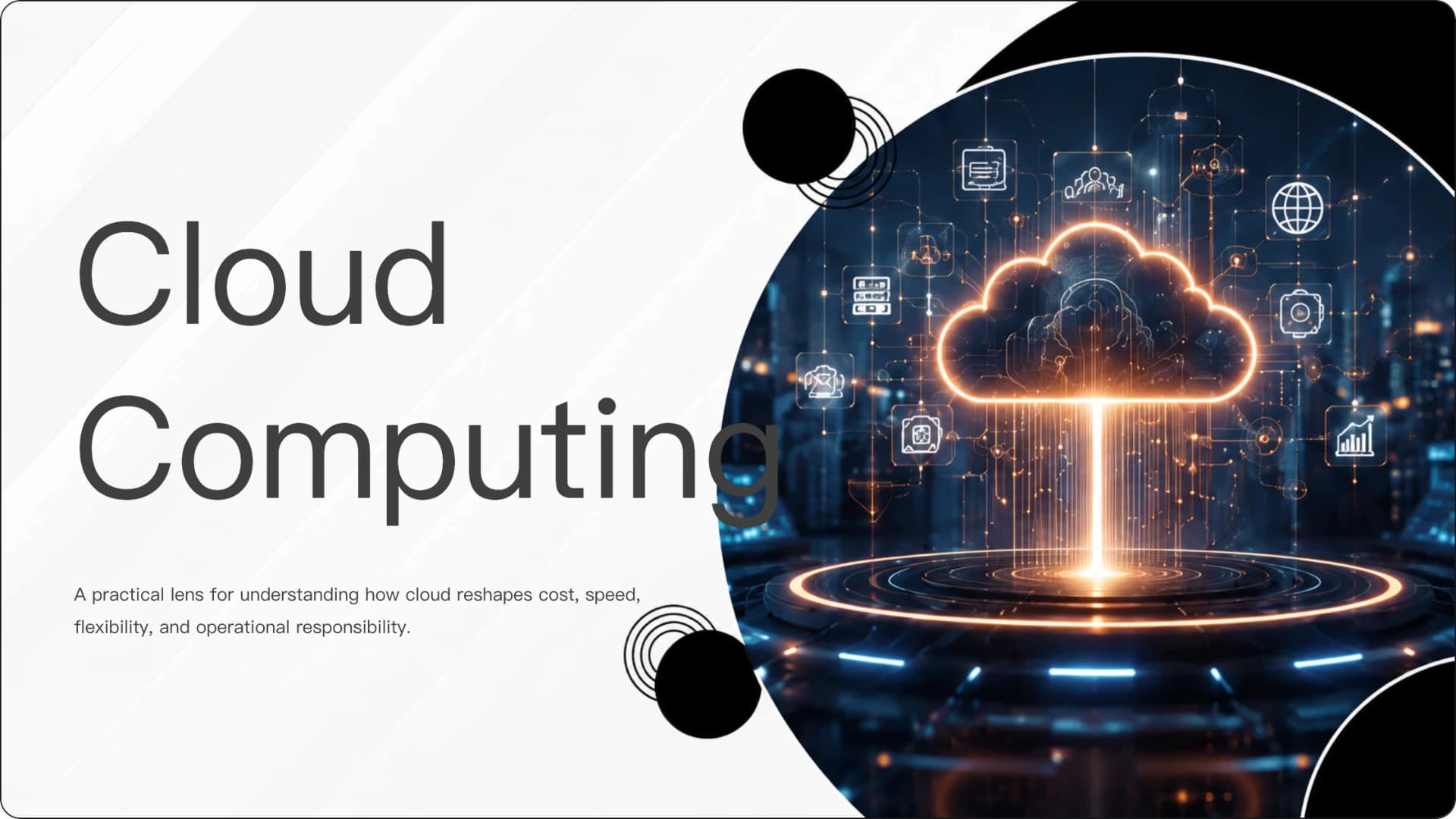
Cloud Computing
A practical lens for understanding how cloud reshapes cost, speed, flexibility, and operational responsibility.
Agenda
Show full textCollapse
The cloud turns IT resources into an on-demand service
Users consume configurable infrastructure and software through services instead of managing every underlying component directly.
Show full textCollapse
Service models shift responsibility from customer to provider
From maximum control to maximum convenience: as provider management increases, customer infrastructure responsibilities decrease.
Show full textCollapse
Deployment models balance flexibility against control
The right environment depends on how much control, accessibility, and resource sharing each workload requires.
Show full textCollapse
Cloud adoption improves speed and elasticity
Technology capacity becomes faster to access and easier to adjust as demand changes.
Show full textCollapse
Cloud flexibility comes with new management responsibilities
Cloud benefits are not automatic: cost, security, reliability, and dependency must be actively managed.
Show full textCollapse
Cloud strategy succeeds when governance shapes the migration
Show full textCollapse
Show all 9 slides
Next Steps
Show full textCollapse
Best for
- Executive cloud adoption briefings
- Cloud migration strategy proposals
- IaaS, PaaS, and SaaS comparison presentations
- Public, private, and hybrid cloud decision reviews
- Cloud readiness assessment presentations
- Cloud governance and migration workshops
Who this template is for
- CIOs and IT leaders
- Cloud architects and infrastructure teams
- Digital transformation leaders
- Technology consultants
- Enterprise technology strategists
- Cloud migration program managers
Features of this template+
- High-contrast white editorial layouts with circular image framing, dark cloud photography, and warm orange highlights
- Four-part cloud service pyramid covering on-demand access, shared resources, rapid scaling, and usage-based consumption
- Three-column IaaS, PaaS, and SaaS comparison focused on shifts in customer and provider responsibility
- Public, private, and hybrid cloud comparison layouts for deployment-model evaluation
- Benefit and responsibility slides covering elasticity, cost governance, security, resilience, and dependency
- Migration governance and next-step layouts for workload selection, readiness assessment, pilot planning, and roadmap sequencing