Free template
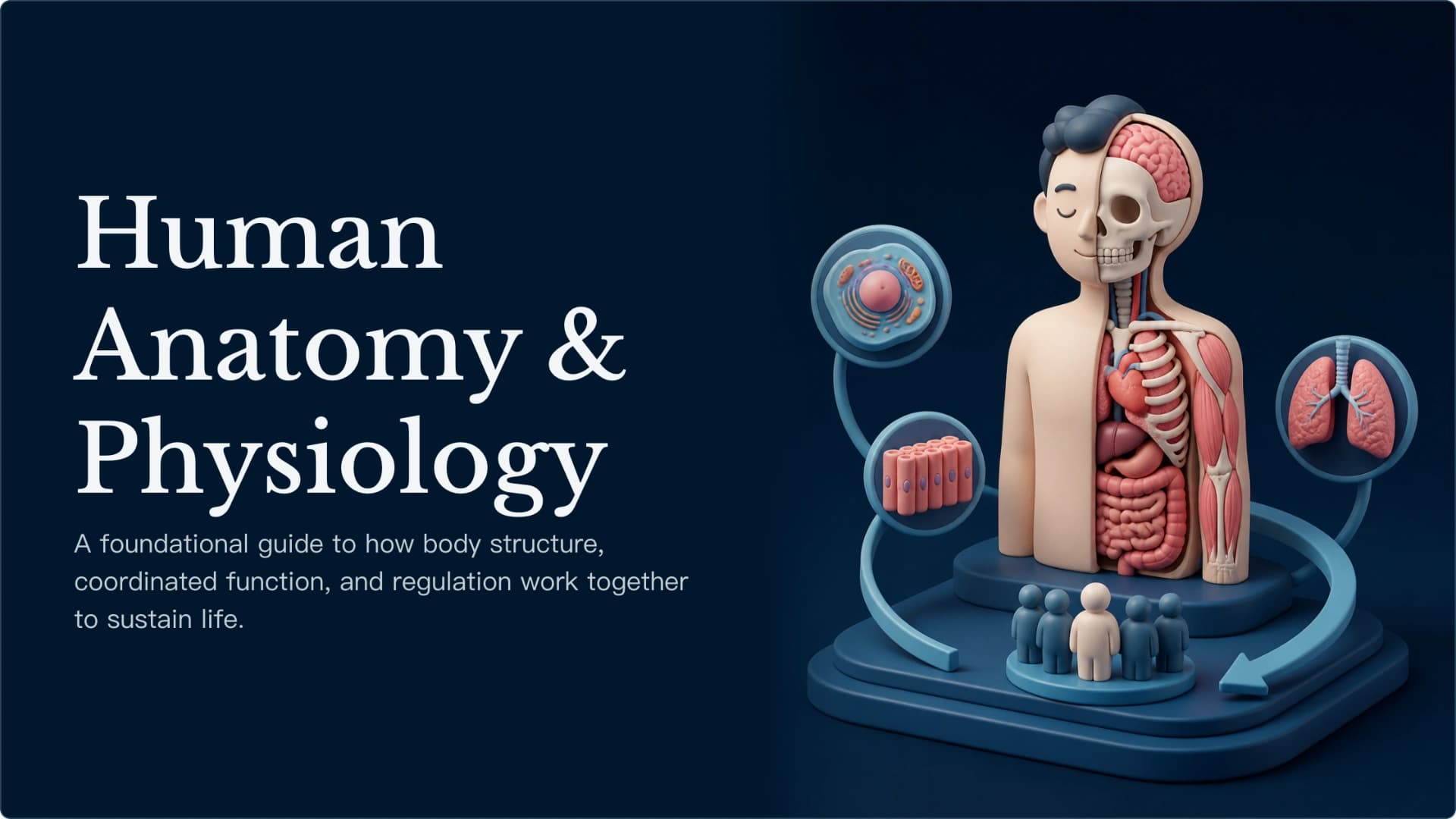
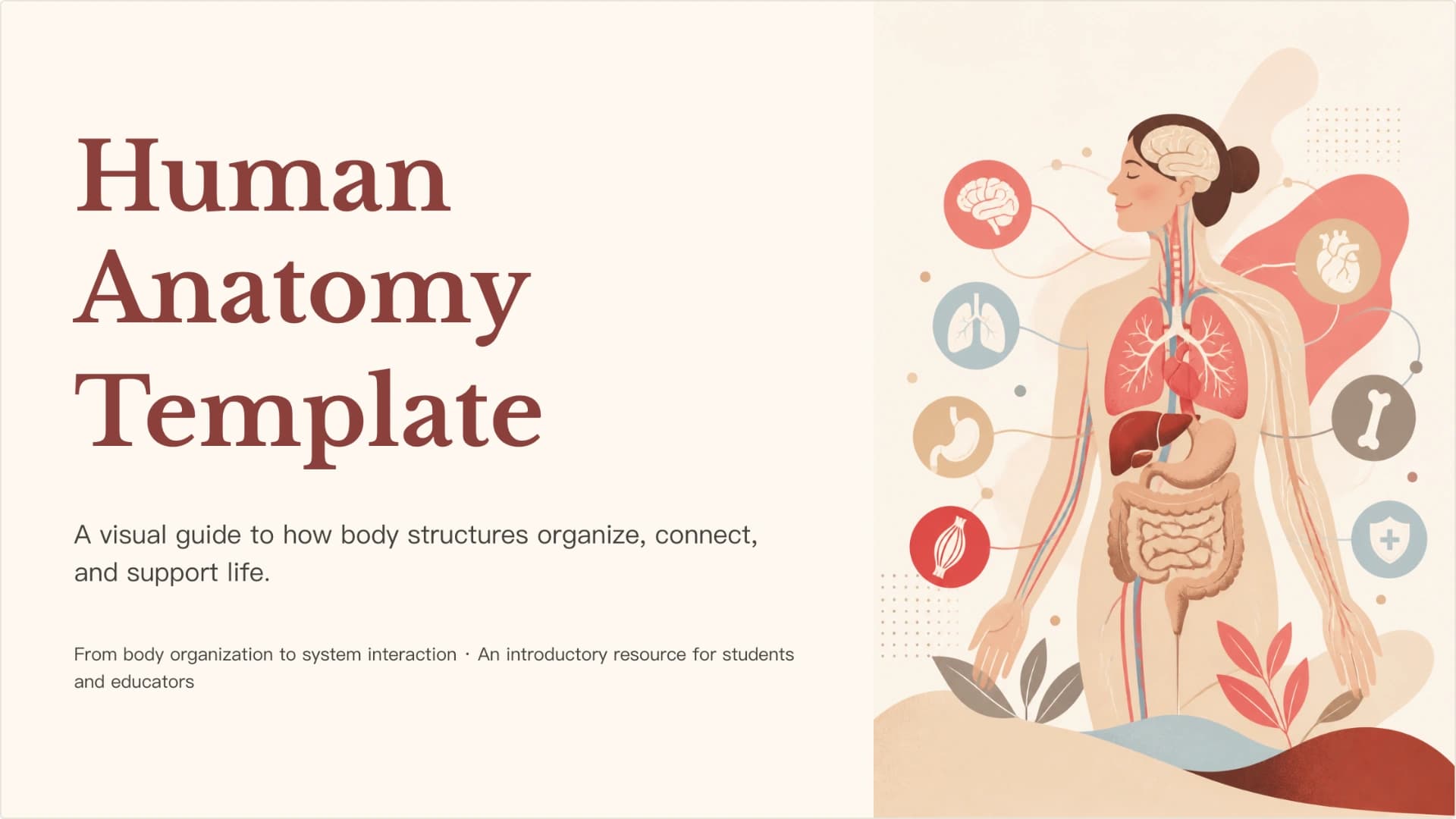
Human Anatomy PPT Presentation Template for Body Systems & Functions
This Human Anatomy PPT template is built for teaching how body structures are organized, located, and connected to function. The slide story moves from the five levels of anatomical organization into directional terms and body planes, then explains the musculoskeletal system, circulation and breathing, digestion and waste control, nervous versus endocrine signaling, protective barriers, and whole-body system interaction. A final synthesis slide reinforces the idea that structure supports function and that body systems work together rather than in isolation. The visual system uses a warm cream background, burgundy and coral accents, muted blue-gray and taupe details, serif display headings, and soft editorial anatomy illustrations. Signature slides include a five-level pyramid, directional-anatomy diagram, movement framework, exchange-system process, side-by-side control-system comparison, protection cards, and a horizontal system-interaction timeline. The editable PPT deck suits introductory anatomy lessons and can be adapted for PowerPoint and Google Slides.
Explore DeckGist's AI presentation maker to turn anatomy notes and course materials into structured, editable presentations.
Create your own presentation with this template
Keep this template’s layout, colors, and visual style. Just enter your topic or upload your materials.
Template selected
Colors, layout, and visual style will be preserved
Supports documents, PDFs, PPTs, and text files
Generate an editable presentation
AI organizes your content and completes the layout
What’s included
Human Anatomy
Template
Show full textCollapse
Anatomy Is Organized Across Five Levels
Think from small to whole: each level depends on the organization and performance of the levels beneath it.
Show full textCollapse
Directional Language Makes Anatomy Precise
Start with anatomical position, then describe every structure relative to that reference.
Show full textCollapse
Bones and Muscles Build Movement
Movement is not produced by muscles alone; it emerges from coordinated action across the entire musculoskeletal system.
Show full textCollapse
Circulation and Breathing Form One Exchange System
Because the systems are interdependent, disruption in breathing or blood flow can limit oxygen delivery and cellular energy production.
Show full textCollapse
The Body Processes Materials and Controls Waste
Together, digestion, absorption, filtration, and elimination manage what enters, circulates, and leaves the body.
Show full textCollapse
Control Systems Coordinate the Body’s Responses
Together, these systems connect perception and decision-making with growth, metabolism, stress responses, and internal balance.
Show full textCollapse
Protection Begins at the Body’s Boundaries
Protection is both a physical boundary and an active biological process.
Show full textCollapse
Show all 10 slides
Health Depends on System Interaction
Show full textCollapse
Structure Is the Foundation of Function
Use anatomical position and directional terms to locate structures precisely. Then connect each structure to its function and relationships with other systems—an approach that supports health science, physical education, medicine, and everyday body awareness. Continue by applying this framework to selected organs, systems, or clinical examples.
Show full textCollapse
Best for
- Introduce the five levels of anatomical organization from cells and tissues to organ systems and the whole organism
- Teach anatomical position, body planes, and directional terminology with a visual reference diagram
- Explain how bones, muscles, joints, and connective tissues work together to produce movement
- Present how respiratory and circulatory systems cooperate in oxygen and carbon dioxide exchange
- Compare nervous and endocrine control systems by signal type, response speed, reach, and duration
- Summarize how multiple organ systems interact to maintain homeostasis, movement, protection, and internal balance
Who this template is for
- Secondary school biology teachers
- College anatomy and physiology instructors
- Health science educators
- Anatomy and physiology students
- Nursing and allied health students
- Physical education instructors
Features of this template+
- Warm cream educational design with burgundy, coral, muted blue-gray, and taupe accents plus soft editorial anatomy illustrations
- Five-level anatomical organization pyramid covering cells, tissues, organs, organ systems, and the organism
- Directional anatomy slide with anatomical position, body planes, and superior, inferior, anterior, posterior, medial, and lateral references
- System-process layouts for musculoskeletal movement, gas exchange, circulation, digestion, absorption, filtration, and regulation
- Side-by-side nervous versus endocrine system comparison with signal, speed, scope, and duration criteria
- Reusable editable presentation slides designed for PowerPoint and Google Slides workflows