Free template
Market Segmentation Template for Teaching Segments and Targeting
This market segmentation PPT gives a marketing instructor eight slides to explain how a broad market is divided into groups and how one group is chosen as the target. After a cover introducing Northstar Drinks, a fictional beverage brand marked as an example scenario, it defines segmentation in three steps, then covers the four bases of segmentation (geographic, demographic, psychographic and behavioral) and a path from the decision to observable variables and survey or purchase data. The second half compares three segments by need and preferred channel, then scores each on measurable, substantial, accessible and aligned-with-brand criteria in a table marked as illustrative data. A worked example explains why busy commuters win with 19 out of 20, and a three-step classroom exercise closes the deck. Navy backgrounds, slanted coral and lavender cards, condensed headlines and lifestyle photo panels give this marketing presentation a bold, energetic look. The editable PowerPoint slides can also be converted for Google Slides.
Explore Deckgist's AI presentation maker to turn lecture notes, survey results and market research PDFs into a structured, editable segmentation presentation.
Create a presentation with AI
Enter a topic or upload reference files, then choose a theme to create a new presentation.
Create with a theme
Enter a topic or upload reference files, then choose a theme to create a new presentation.
Supports documents, PDFs, PPTs, and text files
Generate an editable presentation
AI organizes your content and completes the layout
No topic or upload needed
No topic or upload needed
What’s included
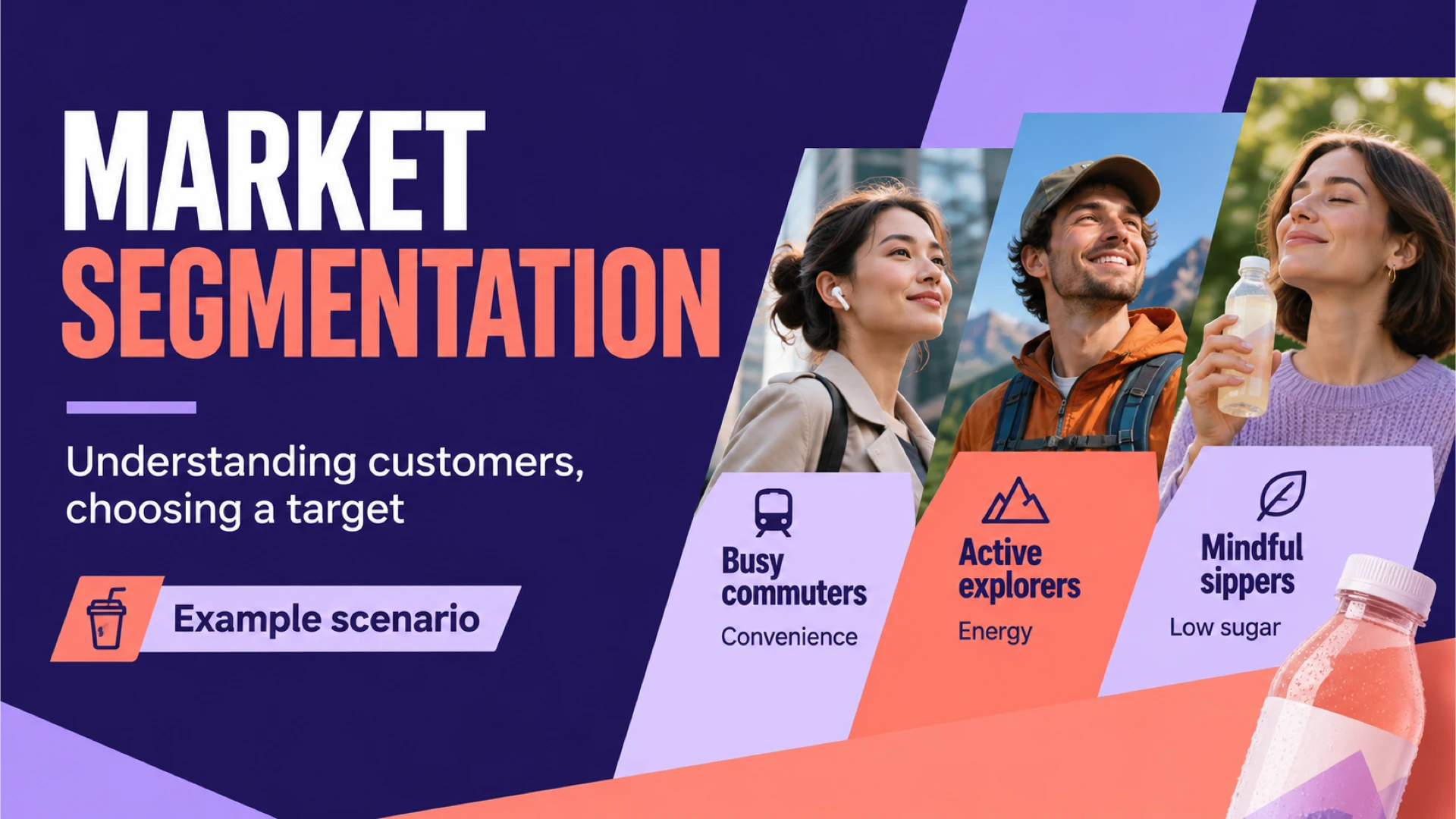
Market segmentation cover
Cover slide titled Market Segmentation with the subtitle Understanding customers, choosing a target, an Example scenario label and three segment cards: Busy commuters (Convenience), Active explorers (Energy) and Mindful sippers (Low sugar).
Show full textCollapse
What is market segmentation?
Defines market segmentation as dividing a broad market into groups with shared needs or behaviors, shown as three steps: identify meaningful differences, compare attractive groups and choose a target to serve, plus a fictional beverage brand example.
Show full textCollapse
Four bases of segmentation
Four slanted cards explain geographic (location), demographic (age and life stage), psychographic (values and lifestyle) and behavioral (usage and benefits) segmentation, each with an icon and a photo panel.
Show full textCollapse
Choose variables and data
Three-step flow: define the decision, select observable variables and gather survey and purchase data, with examples from the fictional brand Northstar Drinks surveying occasions, sugar preference and mobile-order frequency.
Show full textCollapse
Compare three segments
Comparison table of three segments with their key need and preferred channel: busy commuters (convenience, mobile), active explorers (energy, specialty stores) and mindful sippers (low sugar, grocery).
Show full textCollapse
Evaluate segment attractiveness
Scoring table rating three segments from 1 to 5 on measurable, substantial, accessible and aligned with brand criteria; totals are 19 for busy commuters, 13 for active explorers and 16 for mindful sippers, marked as illustrative data.
Show full textCollapse
Northstar Drinks chooses a target
Worked example selecting busy commuters as the target segment for a convenient low-sugar drink, with reasons: a mobile-first purchase path, an on-the-go need and the highest illustrative fit score of 19 out of 20.
Show full textCollapse
Classroom exercise
Student exercise in three numbered steps: name the product, describe two customer groups and use one criterion to justify the target.
Show full textCollapse
Best for
- Lecture introducing market segmentation and the four segmentation bases
- Classroom walkthrough of choosing variables and data for a segmentation decision
- Side-by-side comparison of customer segments by need and preferred channel
- Segment attractiveness scoring workshop using measurable, substantial, accessible and brand-fit criteria
- Worked target-market selection example followed by a student exercise
Who this template is for
- Marketing instructors and lecturers
- Business school students
- Marketing students preparing class presentations
- Brand and marketing managers explaining targeting decisions
- Corporate trainers teaching marketing fundamentals
Features of this template+
- Four bases of segmentation as slanted cards: geographic, demographic, psychographic and behavioral, with line icons and photo panels
- Three-step flow slides from segmentation concept to variables and data, with numbered steps and arrows
- Segment comparison table covering need and preferred channel for three customer groups
- Scoring table rating each segment 1 to 5 on four criteria with a highlighted total column
- Navy background with coral and lavender parallelogram cards, condensed two-colour headlines and lifestyle photo panels
- Editable PowerPoint slides that can be exported as PPT or converted for Google Slides