Free template
Nationalism in India History Lesson Presentation with Timeline and Source Activities
This Nationalism in India PPT gives history teachers an eight-slide lesson that moves from an inquiry question to evidence-based discussion. The cover asks how diverse groups turned anti-colonial protest into a mass movement between 1914 and 1930, and the slide deck then follows a clear story: historical context, a dated movement timeline, the perspectives of key groups, a campaign comparison matrix, a source analysis activity, discussion questions and takeaways with an NCERT reference. Specific structures carry the teaching. A four-point timeline marks 1919 Rowlatt Act protests, the 1920 Non-Cooperation programme, its 1922 withdrawal and the 1930 Salt March; one table contrasts Congress leadership, peasants and plantation workers; another compares Non-Cooperation with Civil Disobedience. Every content slide includes an example activity or question. The visual system uses warm ivory paper, deep brown headings, rust accents and sepia illustrated scenes, suiting a classroom history education presentation. The PowerPoint file can also be opened through Google Slides conversion.
Use Deckgist's AI presentation maker to turn textbook chapter notes or a lesson plan PDF into a structured, editable history presentation.
Create a presentation with AI
Enter a topic or upload reference files, then choose a theme to create a new presentation.
Create with a theme
Enter a topic or upload reference files, then choose a theme to create a new presentation.
Supports documents, PDFs, PPTs, and text files
Generate an editable presentation
AI organizes your content and completes the layout
No topic or upload needed
No topic or upload needed
What’s included
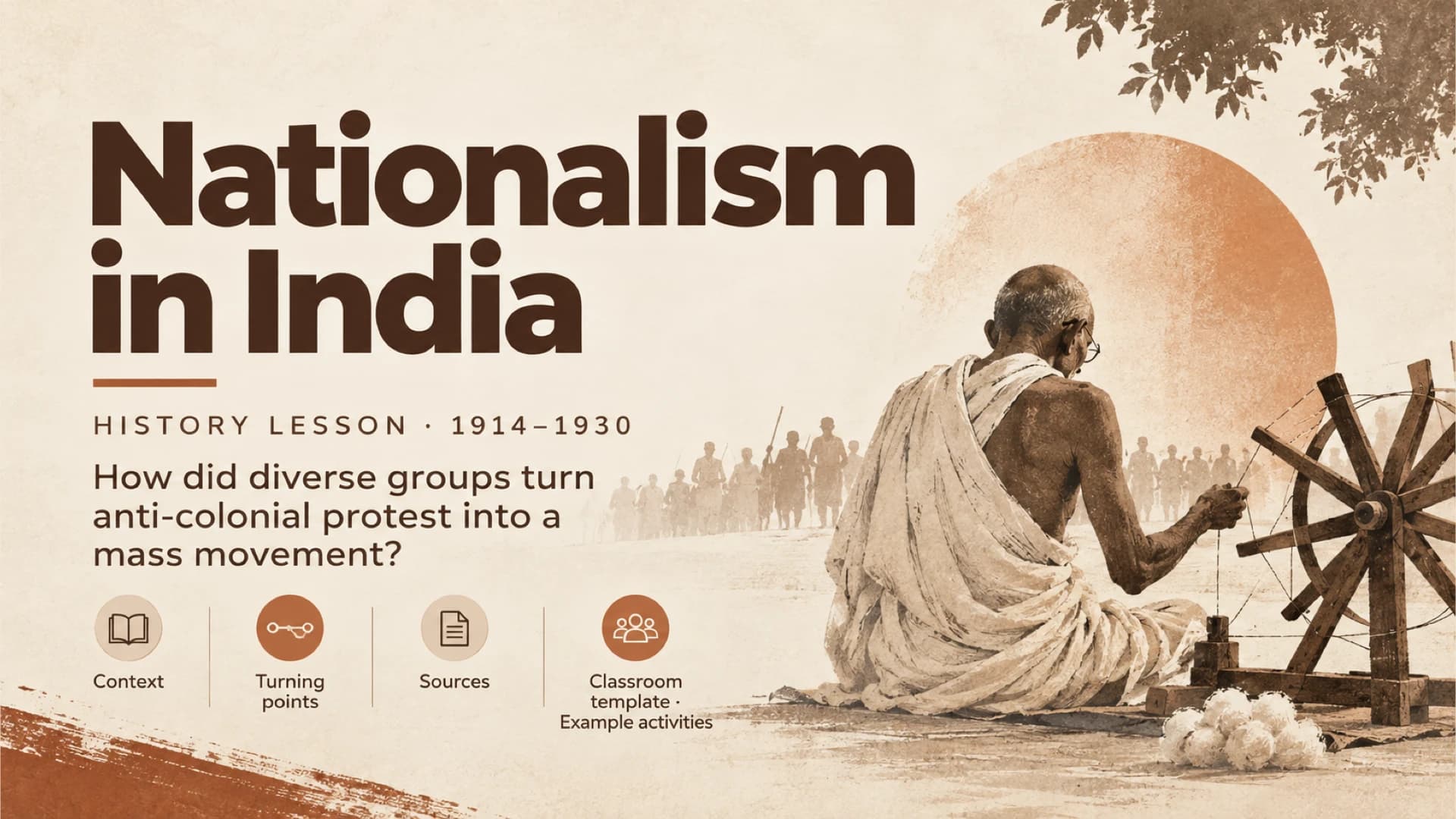
Nationalism in India history lesson cover
Cover slide for a 1914–1930 history lesson that asks how diverse groups turned anti-colonial protest into a mass movement.
Show full textCollapse
Historical context and source map
Links wartime pressure in 1914–18, the 1919 Rowlatt Act and the 1920 shared campaigns, then sets up an example evidence-reading table.
Show full textCollapse
Movement timeline of key events
A four-point timeline of the national movement with an example cause-and-consequence activity.
Show full textCollapse
Key actors and perspectives
An example comparison activity showing how Congress leadership, peasants and plantation workers experienced and shaped the movement.
Show full textCollapse
Events and responses comparison matrix
Compares the Non-Cooperation and Civil Disobedience campaigns by action and inquiry question, followed by an example inquiry activity.
Show full textCollapse
Source analysis activity
A four-step method for reading historical sources critically, with an example scenario and a key question.
Show full textCollapse
Discussion and knowledge check
Three numbered discussion questions and an example response for checking understanding.
Show full textCollapse
Takeaways and references
Three closing takeaways and an NCERT textbook chapter reference for the lesson.
Show full textCollapse
Best for
- Teach a secondary history lesson on Nationalism in India from 1914 to 1930
- Explain the Rowlatt Act, Non-Cooperation and the Salt March on a classroom timeline
- Run a source analysis activity comparing a newspaper report with a personal account
- Compare how Congress leaders, peasants and plantation workers understood swaraj
- Lead a discussion and knowledge check at the end of a national movement unit
Who this template is for
- Secondary school history teachers
- Social studies teachers
- Students preparing class presentations on the Indian national movement
- History tutors
- Curriculum and lesson planners
Features of this template+
- Inquiry-led cover question with four lesson strands: context, turning points, sources and classroom activities
- Four-point movement timeline from the 1919 Rowlatt Act protests to the 1930 Salt March
- Comparison tables for group perspectives and for Non-Cooperation versus Civil Disobedience
- Four-step source analysis process with an example scenario and key question
- Sepia illustrated scenes, ivory paper texture and bold brown headings with rust accents
- Editable PowerPoint slides with Google Slides conversion available on the template page