Free template
Tissue Culture Presentation Template for Plant Biology Lessons
Explain how plant tissue culture connects a small explant to an established plant with this eight-slide biology education presentation. The lesson introduces explant, in vitro and micropropagation terminology, then follows five linked stages: select, establish, multiply, root and acclimatize. A preparation checklist leads into a table comparing shoot, callus and embryo culture by starting material and teaching focus. A line chart and matching observation table use a clearly labeled synthetic teaching cohort to discuss growth records; they do not represent experimental findings. The final activity asks learners to compare approaches for an ornamental plant and identify conditions requiring specialist validation. Deep teal laboratory scenes, mint emphasis, large white headings and plant-vessel imagery connect the sequence. The English PPT deck supports biology and biotechnology teaching, with a PPTX download and an available Google Slides conversion entry.
For a new biology lesson, use DeckGist's AI presentation maker to organize course notes or a teaching brief into a structured, editable presentation.
Create a presentation with AI
Enter a topic or upload reference files, then choose a theme to create a new presentation.
Create with a theme
Enter a topic or upload reference files, then choose a theme to create a new presentation.
Supports documents, PDFs, PPTs, and text files
Generate an editable presentation
AI organizes your content and completes the layout
No topic or upload needed
No topic or upload needed
What’s included
Plant tissue culture techniques
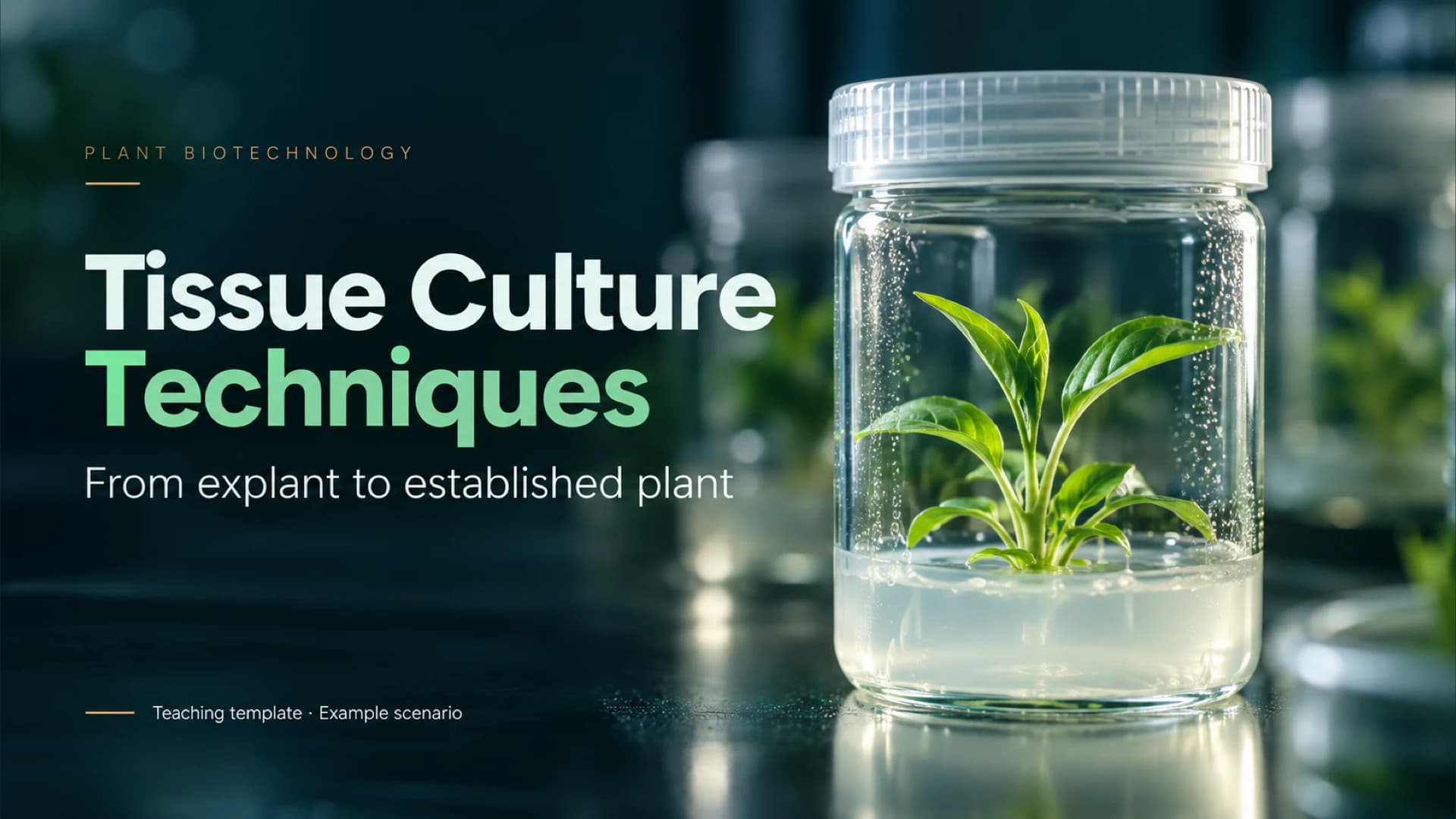
A teaching-template cover introduces the journey from explant to established plant as an example scenario.
Core tissue culture terms
An introductory definition and three illustrated terms explain explant, in vitro and micropropagation in a plant tissue culture example.
Show full textCollapse
Five stages of micropropagation
A connected sequence shows selection, establishment, multiplication, rooting and acclimatization, with observation at every stage and species-specific validation noted.
Show full textCollapse
Prepare a clean starting point
Four prompts cover workspace and materials, explant identification, unexpected-growth observation and recording decisions; the example refers to approved local protocols.
Show full textCollapse
Compare three culture methods
A table compares shoot, callus and embryo culture by starting material and teaching focus, noting that selection depends on species and purpose.
Show full textCollapse
Record growth observations
A line chart and table show illustrative mean shoot lengths of 4, 8, 13 and 18 mm across four weeks for a synthetic teaching cohort.
Show full textCollapse
Discuss an ornamental-plant approach
An example teaching team wants to multiply an ornamental plant; questions ask which methods to compare, what to observe and which conditions need specialist validation.
Show full textCollapse
Review concepts and references
Four takeaways connect explants, culture stages, method comparison and observation records, followed by UF/IFAS and IAEA reference titles.
Show full textCollapse
Best for
- Introduce plant tissue culture terminology in a biology lesson
- Explain the five connected stages of micropropagation
- Compare shoot, callus and embryo culture for a classroom discussion
- Demonstrate how to present synthetic growth observations
- Lead an ornamental-plant method-selection exercise
Who this template is for
- Biology teachers introducing plant tissue culture
- Biotechnology lecturers teaching micropropagation
- Botany instructors discussing plant propagation
- Students preparing a plant tissue culture class presentation
Features of this template+
- Five-stage process slide connects donor tissue selection to acclimatization
- Three-method comparison table pairs starting materials with teaching focus
- Line chart and observation table present a labeled synthetic teaching cohort
- Dark teal laboratory imagery, mint accents and large white headings unify the deck
- Classroom scenario prompts method comparison and specialist validation of conditions
- Eight English slides in 16:9, supplied as a PowerPoint file with a Google Slides conversion entry