Free template
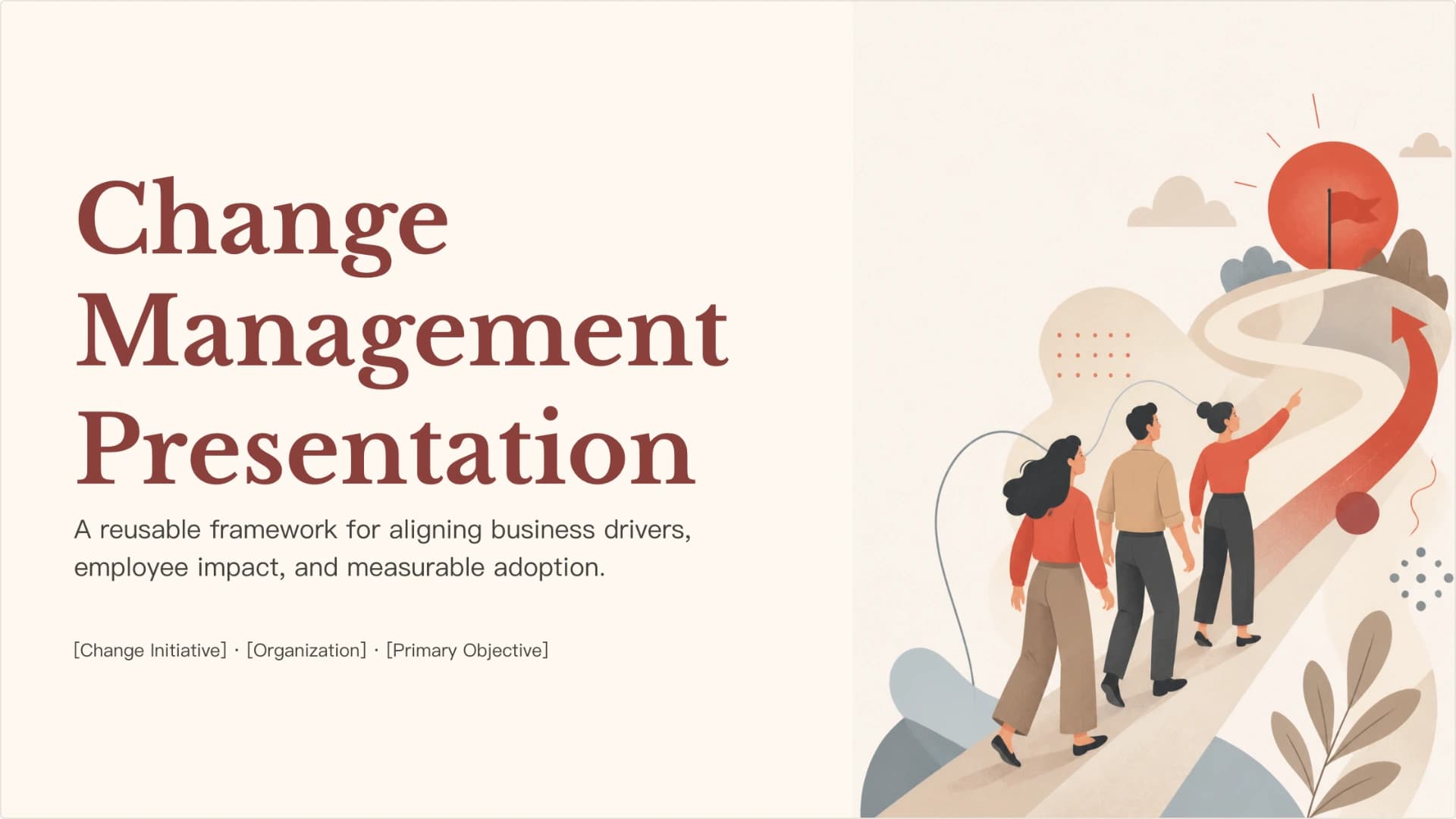
Change Management Presentation Template for Adoption & Stakeholders
This Change Management Presentation Template helps teams explain why change is necessary, define a measurable future state, and turn adoption into an accountable operating plan. The slide story moves from current-state pressures and performance gaps into a current-versus-future comparison, then maps stakeholder groups, adoption workstreams, resistance signals, and a phased roadmap from preparation through reinforcement. A closing slide emphasizes sustained adoption, ownership, and review cadence rather than one-time communication. Visually, the deck uses a warm cream background, burgundy and coral accents, editorial serif headlines, clean sans-serif body text, and soft flat illustrations of people moving toward shared goals. Signature structures include a stakeholder engagement wheel, adoption pyramid, risk-signal timeline, side-by-side state comparison, and six-step execution roadmap. The editable PPT deck fits transformation programs, leadership briefings, HR change initiatives, and project rollouts, with layouts designed for PowerPoint and Google Slides.
Explore DeckGist's AI presentation maker to turn change briefs and stakeholder notes into structured, editable PowerPoint or Google Slides presentations.
Create your own presentation with this template
Keep this template’s layout, colors, and visual style. Just enter your topic or upload your materials.
Template selected
Colors, layout, and visual style will be preserved
Supports documents, PDFs, PPTs, and text files
Generate an editable presentation
AI organizes your content and completes the layout
What’s included
Change Management
Presentation
Show full textCollapse
The Current State Makes Change Necessary
Cost of inaction: [Current Challenge] may continue to drive [Evidence of Impact], increasing [Cost of Inaction] if the organization does not act.
Show full textCollapse
Make the Future State Measurable
Measure outcomes—not activities: training and communications enable adoption; faster decisions, clearer ownership, and improved service define success.
Show full textCollapse
Adoption Requires Stakeholder-Specific Engagement
Assign an engagement owner to each group and tailor what they need to know, do, and believe for adoption to take hold.
Show full textCollapse
Adoption Requires More Than Communication
Coordinate [Change Workstreams] through shared milestones, clear [Key Dependencies], and accessible [Support Channels].
Show full textCollapse
Resistance Signals Where the Plan Needs Reinforcement
Show full textCollapse
A Phased Roadmap Turns Intent into Execution
Show full textCollapse
Sustained Adoption Is the Real Measure of Change
Close the loop with evidence of changed behavior, clear ownership, and continuous reinforcement. Review [Adoption KPIs] with [Business Owner] on the [Review Cadence] and agree the [Next Decision] if adoption stalls.
Show full textCollapse
Best for
- Present the business case for an organizational change initiative and explain why action is required
- Compare the current state with a measurable future state across operating model, ways of working, employee experience, and business outcomes
- Build a stakeholder engagement plan for executive sponsors, people managers, frontline users, and support functions
- Identify adoption barriers and resistance signals that require mitigation or additional support
- Create a phased change implementation roadmap from alignment and preparation through rollout and reinforcement
- Review sustained adoption, ownership, and follow-up actions after a change has been launched
Who this template is for
- Change management leads
- Transformation program teams
- HR and people operations teams
- Organizational development teams
- Project and program managers
- Management consultants
Features of this template+
- Warm cream, burgundy, coral, and muted neutral visual system with editorial serif headings and soft people-centered illustrations
- Current-state versus future-state comparison slide for making expected organizational change measurable
- Stakeholder engagement framework covering executive sponsors, people managers, frontline users, and support functions
- Five-part adoption framework that moves beyond communication into expectations, capability building, behavior reinforcement, and barrier removal
- Resistance-signal timeline and six-step phased roadmap for linking adoption risks to execution and reinforcement
- Structured editable PPT presentation slides designed for PowerPoint and Google Slides workflows