Free template
Critical Thinking PPT Template: Evidence and Argument Lesson
This critical thinking PowerPoint template gives a teacher or trainer an eight-slide classroom lesson on judging evidence and building arguments. It opens with a Think critically cover, then follows one example scenario, a shaded outdoor study area for a school, from claim, reason and evidence through assumptions, source checks, reasoning pitfalls, a two-option comparison, a counterexample and an exit ticket. Signature slides include a Claim, Reason and Evidence chain, three assumption prompts, a Class Survey source card with an 18 of 24 donut chart, three pitfall cards (hasty generalization, false dilemma, appeal to popularity) with a better question for each, and a comparison table of an outdoor area against an indoor quiet room. The look is a torn-paper notebook collage with a warm cream background, navy type, yellow highlighter strokes and blue accents. All figures are fictional survey data, so replace them with your own class evidence. The editable PPT deck can be converted for Google Slides for classroom use.
Planning a different lesson? Try Deckgist's AI presentation maker to turn teaching notes, reading lists, and PDFs into structured, editable presentations.
Create a presentation with AI
Enter a topic or upload reference files, then choose a theme to create a new presentation.
Create with a theme
Enter a topic or upload reference files, then choose a theme to create a new presentation.
Supports documents, PDFs, PPTs, and text files
Generate an editable presentation
AI organizes your content and completes the layout
No topic or upload needed
No topic or upload needed
What’s included
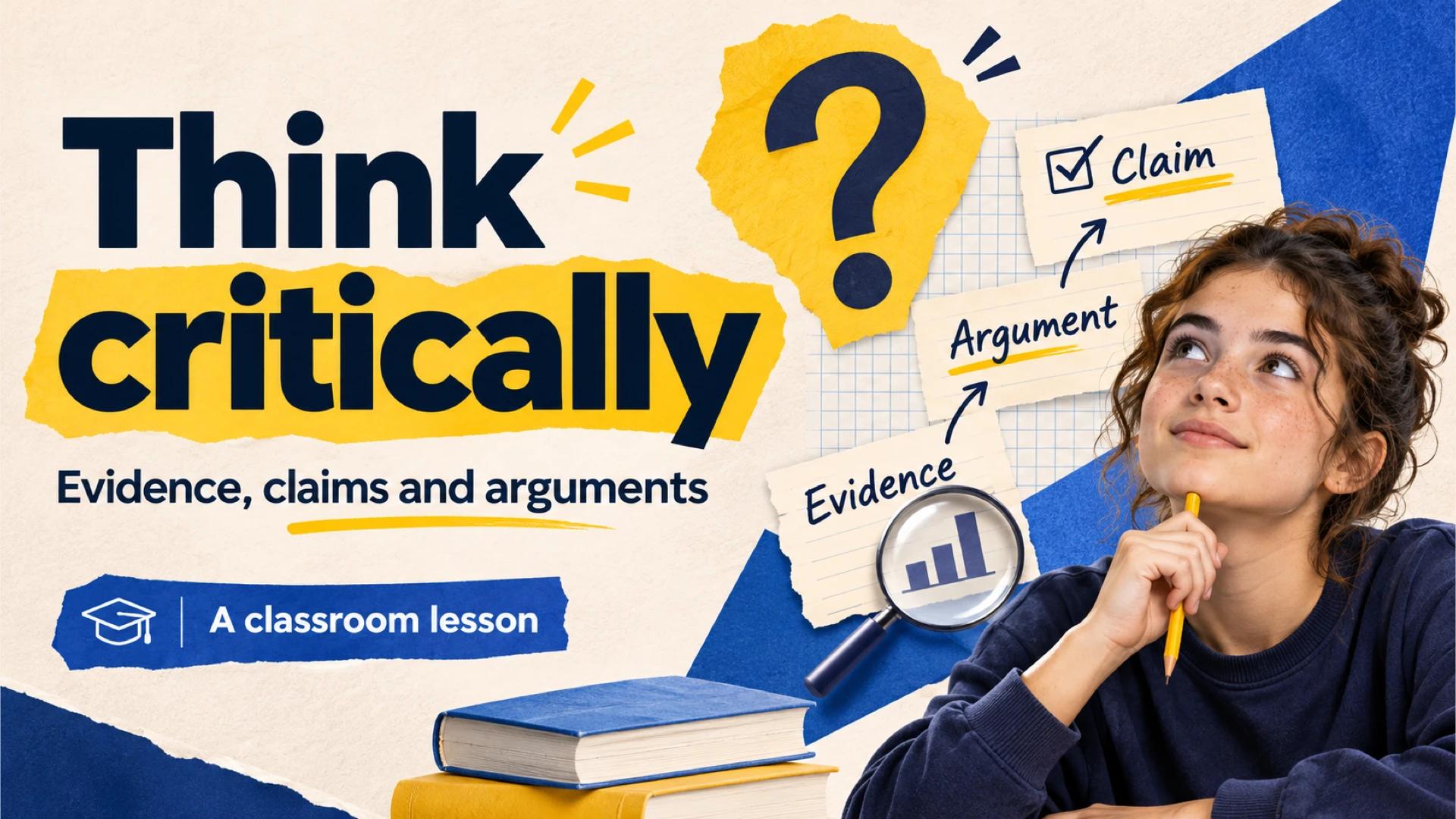
Think critically lesson cover
Cover slide titled Think critically with the subtitle Evidence, claims and arguments and a label reading A classroom lesson.
Show full textCollapse
Build an argument
Slide showing the chain from Evidence to Reason to Claim using a fictional class survey in which 18 of 24 students would use a shaded outdoor study area. Marked as an example scenario.
Show full textCollapse
Question assumptions
Slide testing the hidden musts behind the proposal with three prompts: weather access, affordable installation and no better alternative. Marked as an example scenario.
Show full textCollapse
Check the source
Checklist asking who created it, what evidence supports it and when it was published, applied to a class survey card with an 18/24 (75%) donut chart. Marked as an example scenario.
Show full textCollapse
Spot reasoning pitfalls
Three cards explain hasty generalization, false dilemma and appeal to popularity, each with a sample claim, why it is weak and a better question. Marked as an example scenario.
Show full textCollapse
Compare two arguments
Comparison table of a shaded outdoor study area and an indoor quiet room across evidence, comfort, cost and weather, with a weigh the evidence and constraints note. Marked as an example scenario.
Show full textCollapse
Test a counterexample
Slide asking whether the proposal would help on rainy days, with a counterexample, a possible response and an alternative of pairing with an indoor quiet room. Marked as an example scenario.
Show full textCollapse
Exit ticket
Closing slide with a task to write one claim, add one reason and cite one piece of evidence, an example response, and one question to investigate. Marked as an example scenario.
Show full textCollapse
Best for
- Teach students to separate a claim, a reason and supporting evidence
- Lead a class discussion on the hidden assumptions behind a proposal
- Run a source credibility checklist on a survey or article
- Practise spotting hasty generalization, false dilemma and appeal to popularity
- Compare two arguments using evidence, comfort, cost and weather constraints
- Close a lesson with an exit ticket and a counterexample reflection
Who this template is for
- Secondary school teachers
- Critical thinking and study skills instructors
- Corporate trainers running reasoning workshops
- Curriculum designers
- Student teachers preparing lesson plans
Features of this template+
- Eight slides ordered as a lesson: cover, argument chain, assumptions, source check, pitfalls, comparison, counterexample and exit ticket
- Claim, Reason and Evidence chain with arrows and a worked school example
- Source check slide with a Who, What evidence, When checklist and an 18/24 donut chart
- Three pitfall cards that pair each weak claim with a better question
- Two-option comparison table covering evidence, comfort, cost and weather
- Torn-paper notebook collage in cream, navy and yellow with photos and hand-lettered labels, delivered as editable PowerPoint slides