Free template
Theories of Motivation PowerPoint Template for Organizational Behavior
This theories of motivation PPT template gives organizational behavior instructors an eight-slide PowerPoint deck for comparing four classic theories side by side. A question-led cover leads into a two-lens overview that sets content theories (Maslow and Herzberg) against process theories (Vroom and Adams). The core slides show Maslow's five-level pyramid from basic needs to growth, Herzberg's motivators versus hygiene factors, Vroom's effort, performance and reward chain, and an Adams equity scale weighing your own input and reward against a peer's. A four-row comparison matrix then lists each theory's core driver and a classroom teaching cue. The deck applies the ideas to the fictional Harbor Studio case, sets out three application boundaries, and ends with a three-step practice exercise. The 16:9 design pairs a warm cream background with forest green, coral and amber accents, paper-textured illustrations and arrow-shaped labels. These editable slides suit a human resources presentation or course lecture in PowerPoint and can be converted for Google Slides.
Explore Deckgist's AI presentation maker to turn lecture notes, course readings and HR case studies into structured, editable presentations.
Create a presentation with AI
Enter a topic or upload reference files, then choose a theme to create a new presentation.
Create with a theme
Enter a topic or upload reference files, then choose a theme to create a new presentation.
Supports documents, PDFs, PPTs, and text files
Generate an editable presentation
AI organizes your content and completes the layout
No topic or upload needed
No topic or upload needed
What’s included
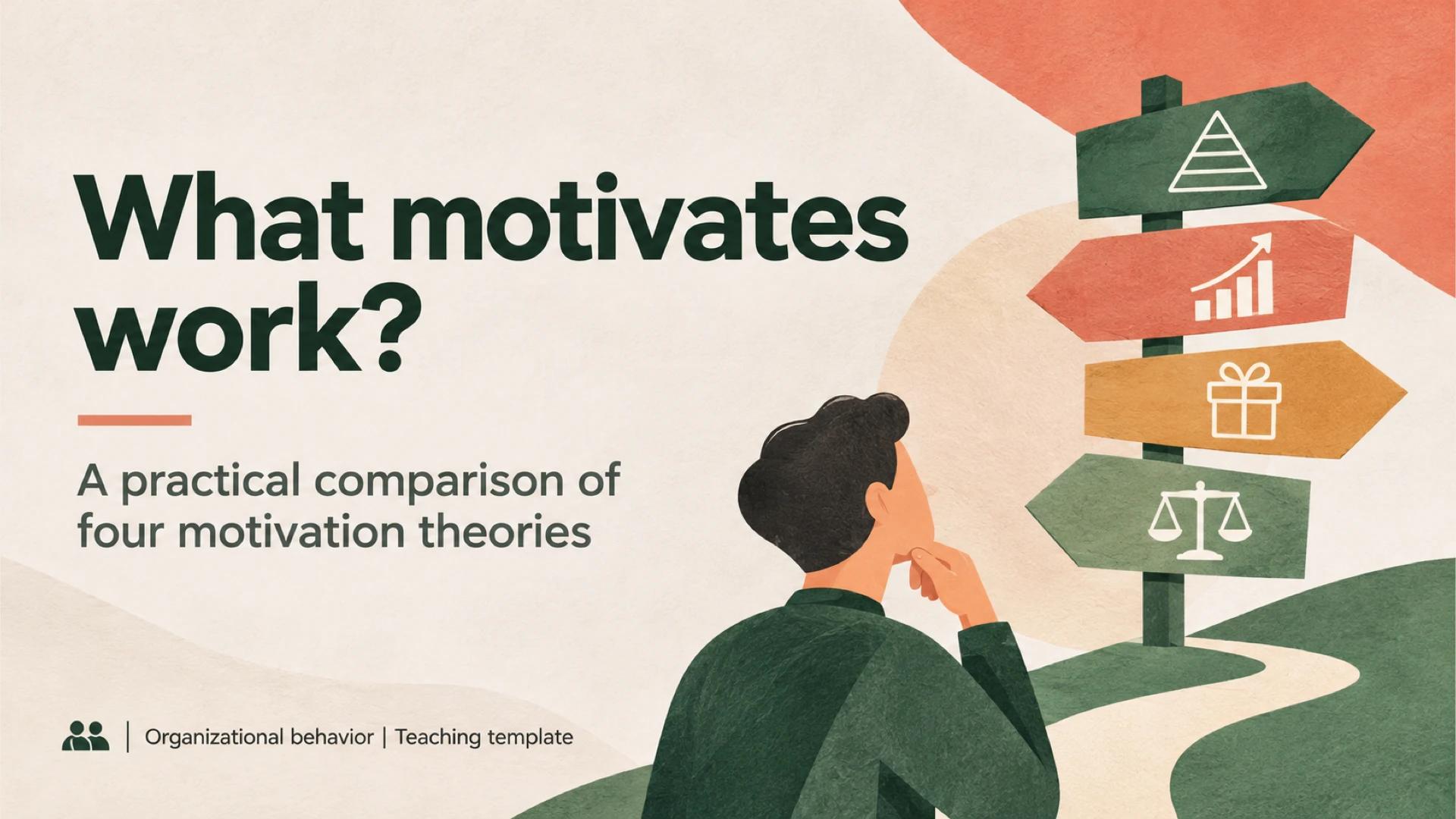
Cover: what motivates work
Question-led cover titled "What motivates work?" introducing a practical comparison of four motivation theories for an organizational behavior class.
Show full textCollapse
Two lenses for motivation
Overview contrasting content theories (what people need: Maslow, Herzberg) with process theories (how people choose to act: Vroom, Adams) around a central motivation target.
Show full textCollapse
Maslow and Herzberg
A five-level needs pyramid (basic needs, security, belonging, esteem, growth) beside Herzberg's motivators and hygiene factors with example items.
Show full textCollapse
How effort becomes motivation
Vroom's effort-to-performance-to-reward chain above an Adams equity scale comparing one's own input and reward with a peer's, with a discussion question.
Show full textCollapse
Four theories, one teaching matrix
A comparison table listing each theory's core driver and a classroom teaching cue for Maslow, Herzberg, Vroom and Adams.
The Harbor Studio Case
A fictional 12-person creative team with unclear recognition and uneven workload, three evidence signals and the question of which theory offers the first useful question.
Show full textCollapse
Use theories as lenses, not labels
Three application boundaries: context changes what people value, fairness judgments are social, and one intervention may solve only one driver, plus a discussion prompt.
Show full textCollapse
Practice the comparison
A three-step exercise: choose a workplace signal, name two competing explanations, draft one testable response, followed by a recap.
Show full textCollapse
Best for
- Teach a lecture comparing content and process theories of motivation
- Explain Maslow's hierarchy of needs alongside Herzberg's motivators and hygiene factors
- Walk students through Vroom's effort, performance and reward chain and Adams' equity comparison
- Run a case discussion using the fictional Harbor Studio team scenario
- Lead a three-step classroom exercise that turns workplace signals into testable responses
Who this template is for
- Organizational behavior instructors
- Business school and management students
- HR trainers and workshop facilitators
- Team leaders learning to diagnose engagement issues
Features of this template+
- Content-versus-process overview slide that frames Maslow, Herzberg, Vroom and Adams
- Five-level Maslow pyramid paired with Herzberg motivator and hygiene factor panels
- Vroom effort-performance-reward chain and Adams equity balance scale diagram
- Four-row comparison matrix with a core driver and teaching cue for each theory
- Warm cream, forest green, coral and amber illustrated design with arrow-shaped icon labels
- Editable PowerPoint slides that can be converted for Google Slides