Free template
Chemistry Slides Template for Teaching Molecules, Atom Counting and Balanced Equations
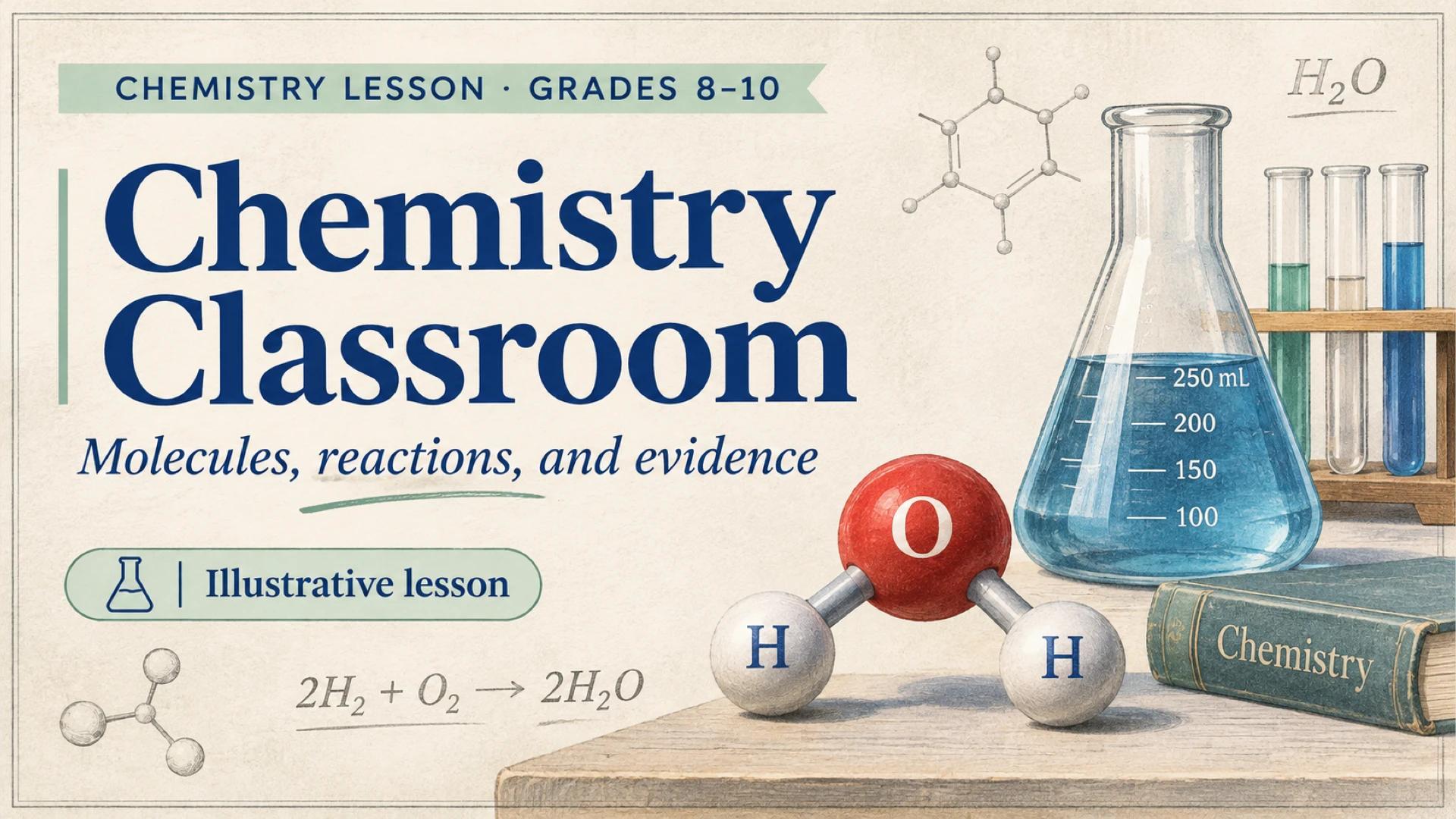
This chemistry slides template gives grades 8–10 teachers an eight-slide lesson that builds from definitions to a practice check. After a cover titled Chemistry Classroom and a four-point learning-goals slide, the deck explains that a molecule contains bonded atoms by placing ball-and-stick models of H₂, O₂ and H₂O side by side. A water-molecule slide then labels oxygen and hydrogen and uses a counting table that totals three atoms, before the next slide balances 2H₂ + O₂ → 2H₂O with matching reactant and product counts of four hydrogen and two oxygen atoms. The second half of the PowerPoint presentation turns to evidence: a bar chart of illustrative data shows reaction time falling from 90 s at 20 °C to 40 s at 40 °C, a question-and-answer slide asks students to count the atoms in 2H₂O, and a Model, count, explain recap closes the lesson. Watercolor flasks, test tubes and a green Chemistry book sit on warm parchment, paired with navy serif headings and soft sage labels. The editable PPT works as a science presentation template in PowerPoint or via Google Slides conversion.
Use Deckgist's AI presentation maker to turn chemistry lesson plans or lab worksheets into structured, editable presentations for your next science class.
Create a presentation with AI
Enter a topic or upload reference files, then choose a theme to create a new presentation.
Create with a theme
Enter a topic or upload reference files, then choose a theme to create a new presentation.
Supports documents, PDFs, PPTs, and text files
Generate an editable presentation
AI organizes your content and completes the layout
No topic or upload needed
No topic or upload needed
What’s included
Chemistry Classroom cover
Cover slide for a grades 8–10 chemistry lesson titled Chemistry Classroom, subtitled Molecules, reactions, and evidence.
Show full textCollapse
What we will learn
Learning-goals slide listing four objectives for the chemistry lesson, each with a round icon.
Show full textCollapse
Atoms combine to make molecules
Defines an atom as a unit of an element and a molecule as bonded atoms, comparing hydrogen, oxygen and water molecules.
Show full textCollapse
Read a water molecule
Explains that H2O contains one oxygen atom and two hydrogen atoms, with a labeled model and an atom-count table.
Show full textCollapse
Atoms rearrange, they do not disappear
Shows the balanced equation 2H2 + O2 → 2H2O with equal hydrogen and oxygen counts for reactants and products.
Show full textCollapse
Temperature and reaction time
Illustrative bar chart showing that, in this example, higher temperatures correspond to shorter reaction times.
Show full textCollapse
Count the atoms
Practice question asking how many atoms of each element are in 2H2O, with the answer and a comparison to the balanced reaction.
Show full textCollapse
Model, count, explain
Lesson recap summarizing three steps for reasoning about molecules and balanced equations.
Show full textCollapse
Best for
- Introduce atoms and molecules in a middle school chemistry class
- Teach students to read the chemical formula and model of a water molecule
- Demonstrate conservation of atoms with a balanced hydrogen and oxygen equation
- Practice interpreting a simple temperature versus reaction-time bar chart
- Run an atom-counting check for understanding at the end of a lesson
- Review modeling, counting and explaining before a chemistry quiz
Who this template is for
- Middle school science teachers
- High school chemistry teachers
- Grades 8–10 chemistry students
- Science department curriculum leads
- Homeschool science educators
- Chemistry tutors
Features of this template+
- Side-by-side ball-and-stick models comparing H₂, O₂ and H₂O molecules
- Reactant and product atom-count tables for the balanced 2H₂ + O₂ → 2H₂O equation
- Horizontal bar chart of example temperature and reaction-time data with an axis in seconds
- Question-and-answer practice slide followed by a three-step Model, count, explain recap
- Watercolor lab illustrations of flasks, test tubes and a chemistry book on parchment texture
- Navy serif headings with sage-green tags across editable PowerPoint slides that convert to Google Slides