Free template
Restriction Enzymes Presentation Template for Biology Lessons
Teach the essentials of restriction enzymes with a ten-slide sequence that moves from recognition sites to DNA fragments. The deck uses EcoRI as a worked example: a six-base-pair recognition sequence, antiparallel strand directions, and staggered cut positions appear in separate diagrams. A side-by-side comparison introduces sticky and blunt ends, followed by a linear 1,200 bp fragment map with cuts at 300 and 800 bp. Later slides connect fragment patterns and DNA maps to conceptual applications, provide a paper-based sequence-matching activity, and close with common misconceptions and a knowledge check. Designed for an introductory biology education presentation, the slides pair a warm ivory background with teal and coral accents, bold dark headings and three-dimensional DNA illustrations. Use the PowerPoint file for a classroom lesson or convert it for Google Slides; check the converted layout before presenting.
For a separate lesson, use the AI presentation maker to turn biology notes or teaching materials into a structured, editable presentation.
Create a presentation with AI
Enter a topic or upload reference files, then choose a theme to create a new presentation.
Create with a theme
Enter a topic or upload reference files, then choose a theme to create a new presentation.
Supports documents, PDFs, PPTs, and text files
Generate an editable presentation
AI organizes your content and completes the layout
No topic or upload needed
No topic or upload needed
What’s included
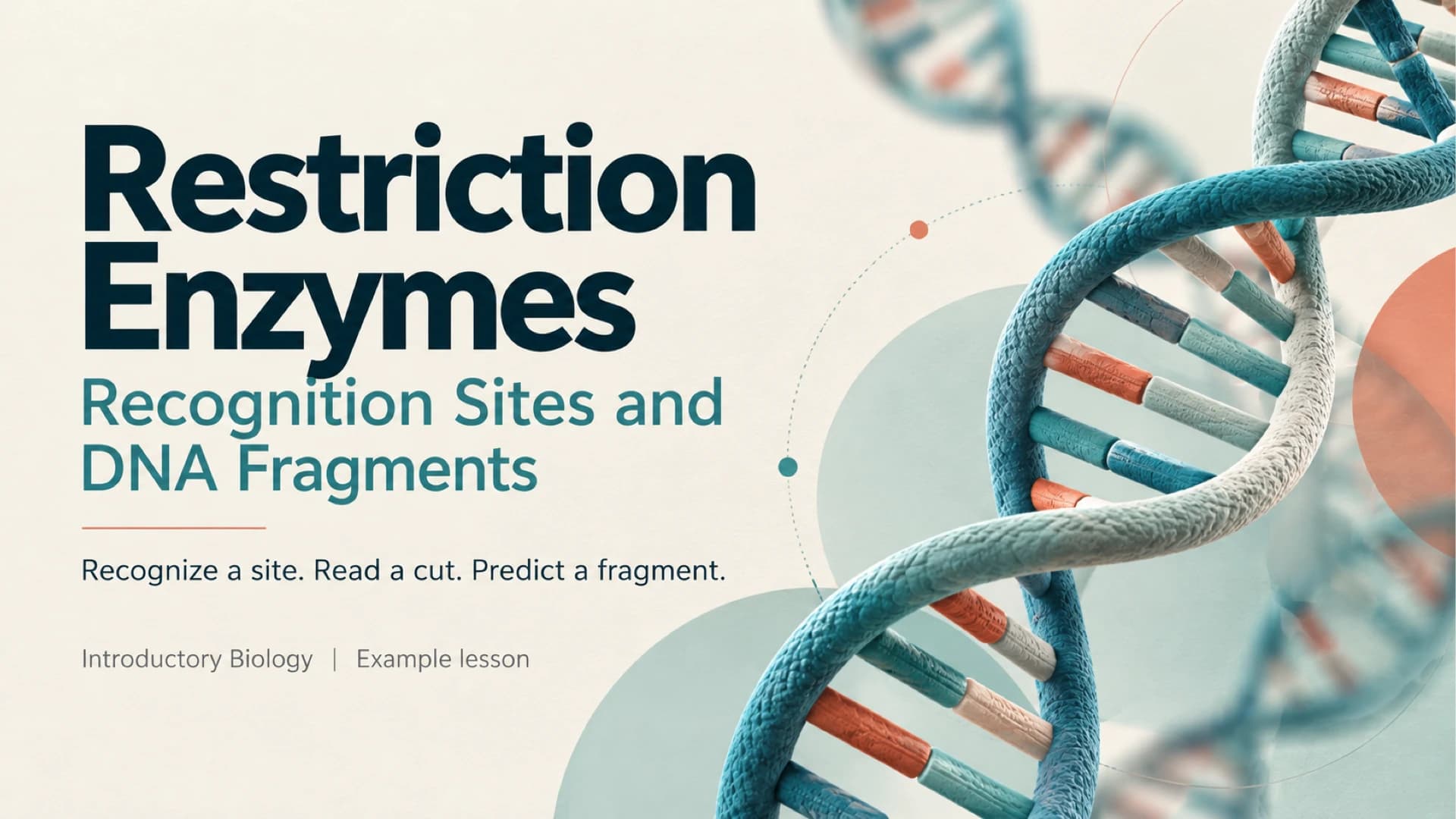
Restriction enzymes lesson cover
An introductory biology lesson on recognition sites and DNA fragments.
Recognition starts with a sequence
An EcoRI example introduces a specific six-base-pair recognition site.
Read the recognition site
The EcoRI example shows antiparallel DNA strands read from 5′ to 3′.
Where a cut occurs
A diagram marks the staggered cut positions within the EcoRI recognition site.
Sticky ends and blunt ends
A comparison illustrates single-stranded overhangs and blunt ends.
Read a simple fragment map
An example 1,200 bp linear DNA map shows two cuts and three resulting fragments.
What restriction enzymes help us study
Three illustrations introduce fragment patterns, DNA assembly concepts and a simple DNA map.
Paper-based matching exercise
An example activity compares three sequence pairs with the EcoRI recognition site.
Show all 10 slides
Three common misconceptions
A comparison table addresses recognition specificity, cleavage and end structure.
Recognize, read and predict
A knowledge check reviews the EcoRI sequence, end types and fragment lengths.
Best for
- Introduce EcoRI recognition sites in an introductory biology lesson
- Explain antiparallel strand reading and staggered cuts
- Compare sticky and blunt DNA ends
- Work through a simple linear DNA fragment map
- Lead a paper-based recognition sequence matching activity
Who this template is for
- introductory biology instructors
- molecular biology lecturers
- biology teaching assistants
- undergraduate biology students
Features of this template+
- EcoRI sequence diagrams show recognition, strand direction and cut positions across separate slides
- Side-by-side sticky and blunt end comparison with labeled DNA illustrations
- A 1,200 bp linear fragment map with example cut positions and fragment lengths
- Sequence-matching exercise, misconception table and three-question knowledge check
- Ivory backgrounds, bold dark headings, teal and coral accents and three-dimensional DNA imagery