Free template
Financial Literacy PPT Lesson on Budgeting, Saving, Credit and Investing
This financial literacy PPT gives teachers and workshop leaders an eight-slide lesson that walks beginners from everyday budgeting to safer money decisions. After a cover previewing Budget, Save, Understand credit and Grow, a sample student budget table splits $1,000 of income into $600 essentials, $250 flexible spending and $150 savings. Next come an income-and-expenses flow of fixed and variable costs, an emergency fund line chart growing from $150 to $600 over four months, and a credit comparison of a $300 purchase paid in full versus a $327 balance carried over six months. Later slides cover investment basics with a simple risk-versus-return chart, a three-card checklist for spotting high-pressure offers and requests for personal information, and a closing action plan. Every page uses deep navy backgrounds, bold white and yellow headlines and warm desk photography of piggy banks, notebooks and coins, with all figures labelled as illustrative examples. As a financial literacy presentation it downloads as editable PowerPoint slides and can be converted to Google Slides.
To build a fresh budgeting or credit lesson from your own material, try Deckgist's AI presentation maker, which turns lesson notes or a PDF worksheet into a structured, editable presentation.
Create a presentation with AI
Enter a topic or upload reference files, then choose a theme to create a new presentation.
Create with a theme
Enter a topic or upload reference files, then choose a theme to create a new presentation.
Supports documents, PDFs, PPTs, and text files
Generate an editable presentation
AI organizes your content and completes the layout
No topic or upload needed
No topic or upload needed
What’s included
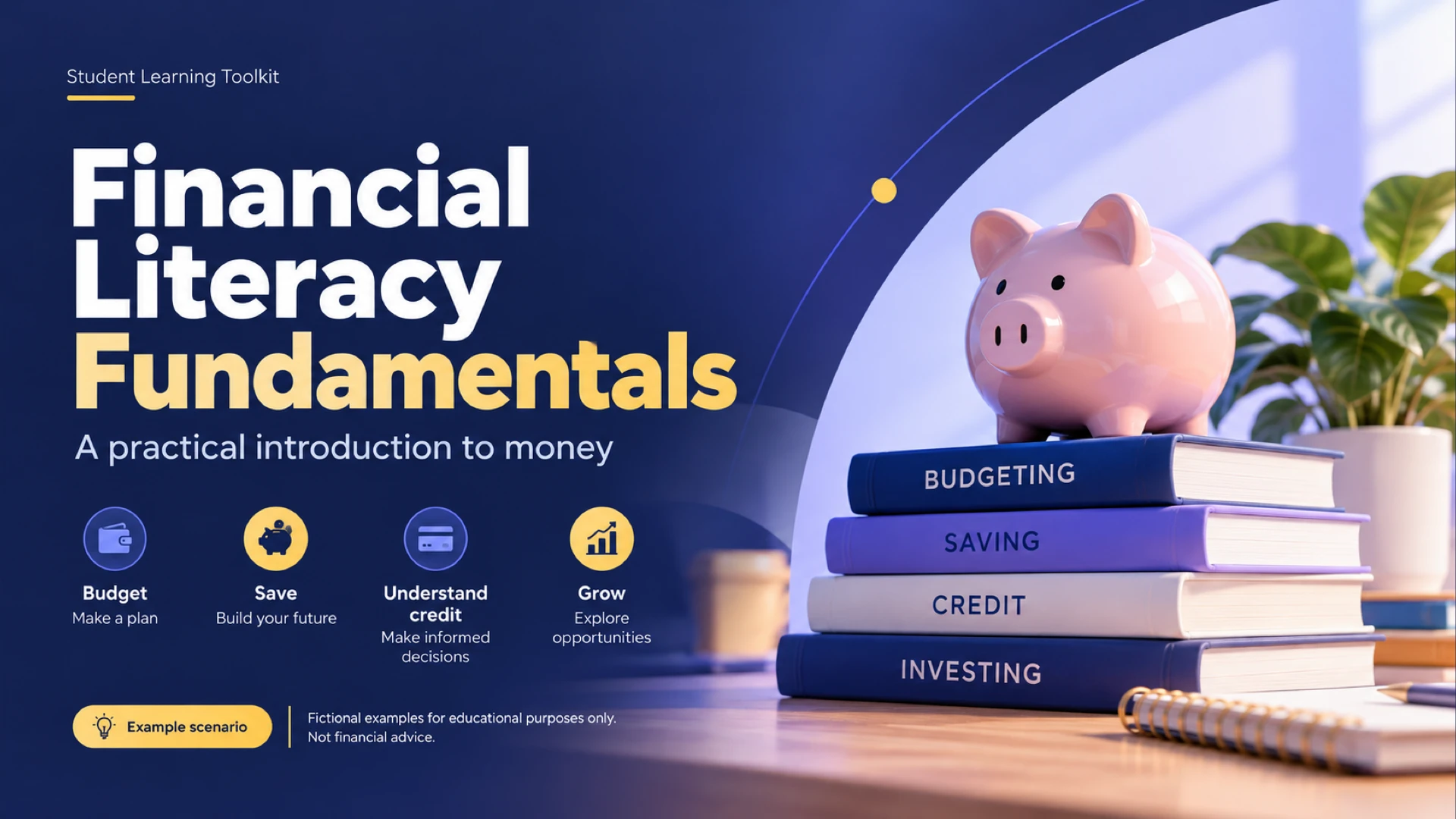
Financial Literacy Fundamentals cover
Cover slide introducing a practical student lesson on money, with four topic icons for budgeting, saving, understanding credit and growing money.
Show full textCollapse
Build a simple monthly budget
A student example budget table splitting $1,000 of monthly income into essentials, flexible spending and savings, with a key takeaway equation.
Show full textCollapse
Understand income and expenses
A flow diagram showing $1,000 monthly income divided into fixed expenses, variable expenses and savings, encouraging learners to track both for a month.
Show full textCollapse
Start an emergency fund
An illustrative savings plan line chart showing an emergency fund growing by $150 a month to $600 after four months, with goal-setting tips.
Show full textCollapse
Borrowing and credit
An example comparing a $300 purchase paid in full by month end with carrying the balance over six months for a total cost of $327, plus a note on payment history.
Show full textCollapse
Investment basics
Introduces diversification, time horizon and the trade-off between risk and potential return using an illustrative chart of cash savings, a balanced fund and shares.
Show full textCollapse
Recognize common risks
A three-step risk check covering high-pressure offers, requests for personal information and unverified sources, with an example scam message.
Show full textCollapse
Your next money steps
A closing action plan asking learners to track one month, build a budget, set an example $150 savings goal and review progress monthly.
Show full textCollapse
Best for
- Teach a high school or college class how to build a simple monthly budget
- Run a first-job or campus workshop on emergency savings and money goals
- Explain the cost of carrying a credit card balance versus paying in full
- Introduce beginners to diversification, time horizon and risk versus return
- Lead a scam-awareness session on high-pressure offers and personal data requests
- Close a personal finance module with a four-step money action plan
Who this template is for
- High school economics and life-skills teachers
- College financial wellness coordinators
- Students learning personal finance for the first time
- Community and library financial literacy educators
- Youth program and NGO workshop facilitators
Features of this template+
- Sample student budget table with income, essentials, flexible spending and savings that add up to $1,000
- Emergency fund line chart tracking savings from $150 to $600 across four months
- Side-by-side credit comparison of a $300 purchase paid in full versus carried over six months
- Risk-versus-return chart placing cash savings, a balanced fund and shares on a 1-to-5 scale
- Deep navy layouts with yellow headline accents, rounded cards and warm desk photography of piggy banks, jars and notebooks
- Editable PowerPoint slides with example-data and not-financial-advice labels, convertible to Google Slides